Penmachine
22 April 2010
Tumours still shrinking
A couple of months ago, my regular CT scan showed the first-ever shrinkage of cancer tumours in my three-year history with the disease, but I warned that, "I still have cancer, a lot of it all over the inside of my chest, but just a little less of it than I did a couple of months ago." One scan was not yet a trend.
But two could be, and my latest scan showed further shrinkage, with the biggest malignant blob in my left lung going from 3.1 cm down to 2.9 cm in diameter, which means it is smaller than it was in this scan from September:
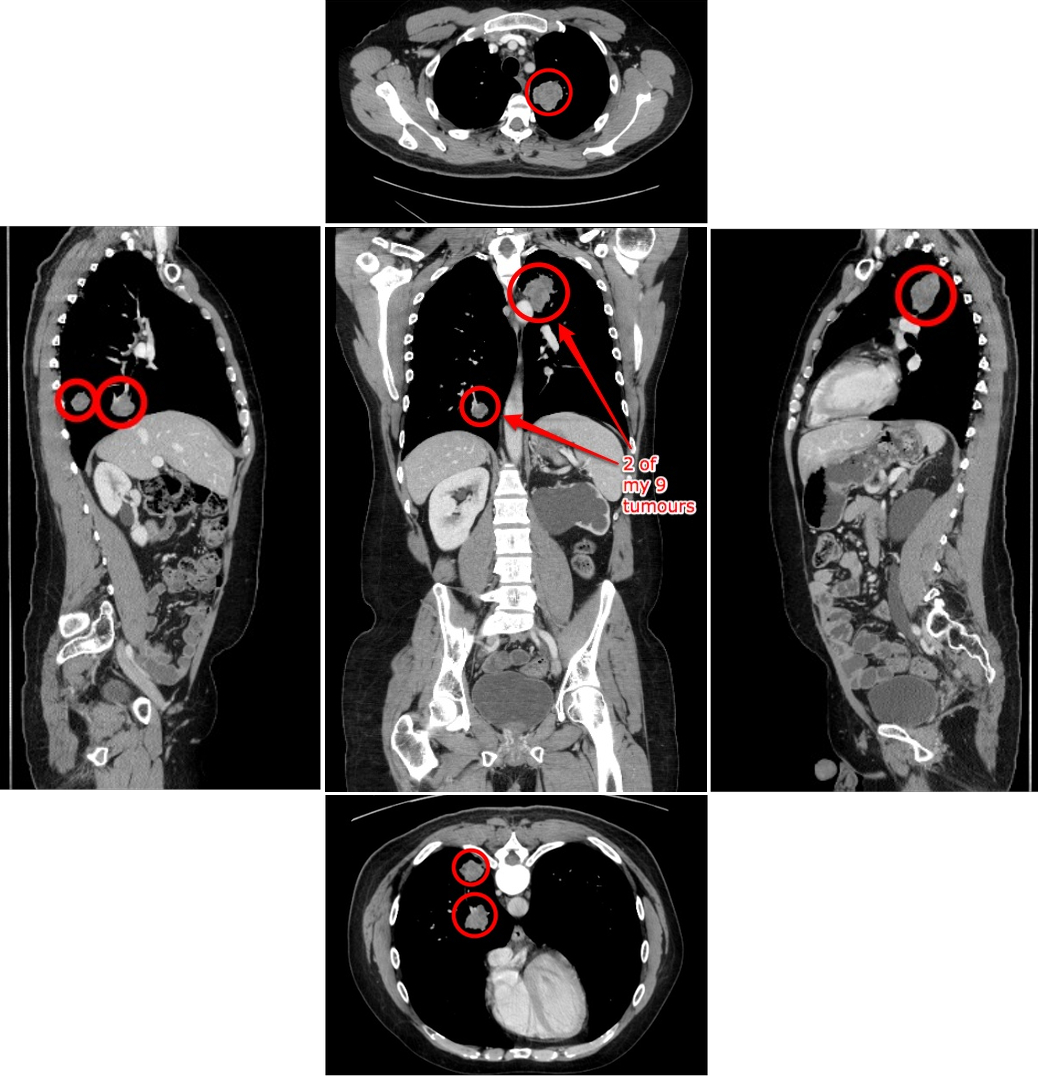
Some of the others have also shrunk, while other smaller tumours have simply not gotten bigger. The aggressive and sometimes horrific chemotherapy I take every two weeks is doing something. I feel pretty good about that.
I'll remind you that this is not remission, not a cure, not me being "all better." I'm not sure if those things will ever come, and I've already beat the odds on this disease by staying alive as long as I have. What it does mean is that I'm likely to live a while longer yet (whatever "a while" is), which is the most realistic thing I can keep hoping for.
Oh, and happy Earth Day, everyone.
Labels: cancer, chemotherapy, news
16 April 2010
Scan and chemo
Today I had yet another CT scan, to see how my various cancer tumours are doing. It probably won't be evaluated by a radiologist for a few days, so it's unlikely to disrupt my next chemotherapy treatment on Monday. But I will communicate soon with my oncologist Dr. Kennecke to find out the results.
Am I nervous? Yes and no. I've been at this so long, having scans every couple of months for over three years now, that I don't find worrying about the results to be too productive. Still, last time the news was somewhat good. I'm a little nervous about that.
Labels: cancer, chemotherapy, ctscan
09 April 2010
Buzz time
Once again, chemotherapy is doing bizarre and nasty things to my hair. It's thinning, while getting wiry and bushy and annoying. But rather than do the full Peter Garrett shave as I did two years ago, I went for my preferred buzz cut again:
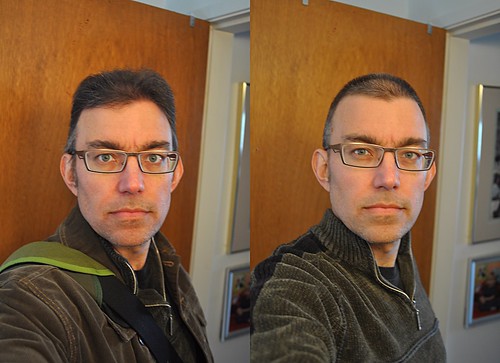
My "before" look on the left was about as as good as I could make it appear, but there was still something vaguely Kim Jong-Il about it. I prefer the shorter version on the right, and I'll try to keep it that way.
Labels: cancer, chemotherapy, photography
27 March 2010
A weird way to hit a weight target
 A few years ago, before I got cancer, my doctor told me that an ideal weight for someone of my height and build was around 185 or 190 pounds (84 to 86 kg). Since I'd been hovering around 200 pounds for some time, I didn't worry too much about it. I was relatively healthy (despite my long-time Type 1 diabetes), eating reasonably well, cycling to and from work, and so on.
Then, of course, came the diagnosis. Over the next three and a bit years, among a hell of a lot of more alarming things, my weight fluctuated wildly—as low as 145 pounds (in mid-2007) and as high as 215 pounds (a couple of years later).
When I started on my latest chemotherapy regimen in December, at first I seemed to be losing about 5 pounds each treatment, which wasn't a good trend. I adjusted what I ate (i.e. more, when I could eat), and things stabilized. Guess where?
Yup, between 185 and 190 pounds, pretty much.
I would not advise this method to reach a weight your doctor recommends for you, however.
Labels: cancer, chemotherapy, food
16 March 2010
The end of my live music career?
 This piece is a text transcript of my segment on the latest episode (#79) of my podcast Inside Home Recording.
Most of my music career has had nothing to do with recording. It's been about playing live, mostly in a cover band. I've been doing that since 1989, more than twenty years. And I think that has now come to an end. Let me explain.
The first live performance I remember giving was on nylon-string guitar, to a group of senior citizens, I think at a music recital at a local church. It was organized through my elementary school, about 30 years ago. I was playing "Romanza," a well-known classical piece. And I forgot to tune my guitar beforehand. They applauded anyway, and I learned my lesson.
A few months later I played the same piece for a school talent contest. I remembered to tune this time, and I won the contest. But it was nerve-wracking. While I loved being in plays and skits, I found precision of live music performance a bit terrifying.
After I took my Grade 4 Royal Conservatory guitar exam in 1982, and then changed high schools, I quit guitar lessons, and stopped playing, and forgot everything, including how to read music. Every once in awhile I'd be startled by a string breaking inside the guitar case in my closet, but I never even bothered opening it.
I was inspired to take up music again at the end of 1987, when I discovered I could play drums half-decently without ever having tried it before. In 1988, my roommate Sebastien and I decided to form a band with our other roommates Alistair and Andrew, and my friend Ken. We'd all play instruments, and we'd all sing.
One day Sebastien and I went out with the agreement that I would buy a drum kit and he would buy an electric guitar. We got the cheapest, crappiest instruments we could find at pawn shops, and we were on our way.
The next lesson came when the bunch of us got paid for a show. But we didn't use our instruments, because it was a lip-sync contest at UBC. We were very silly and overblown, with costumes, makeup, props, a giant wall constructed of cardboard boxes (for a Pink Floyd song) and even some unauthorized flames (for our Alice Cooper impression). We won, and received $600. That was more than we'd get paid for a gig for quite a long time.
The lesson was that showmanship was important. Sometimes more important than musical skill or talent, especially when you're starting out and don't even know how to sing proper harmonies. You need to put on a damn show.
Our first real gig, in the spring of 1989, was at a year-end university party where we sounded great because the audience was really drunk. We played up the schtick, calling ourselves the Juan Valdez Memorial R&B Ensemble (though we played little R&B) and featuring Batman logos on our instruments and T-shirts, for no particular reason other than that we played the theme from the "Batman" TV show.
In some form or another, Sebastien and I have played in bands together on and off ever since, me on drums and him on guitar. We even tried it full-time for awhile in the mid-1990s, with a short-lived original act called The Flu we took as far as Australia, and cover bands with names like The Love Bugs, HourGlass, and The Neurotics to pay the bills. Sometimes we busked in downtown Vancouver for spare change. The direct rewards were a great way to learn what people liked, or at least what they'd pay for.
I left the band for a few years after I got married and had kids, but still guested when they needed a drummer in a pinch from time to time. I returned in the early 2000s when the gigs were more stable and better paying. We even got flown to New York City once for a single night's show in the fancy Sherry-Netherland Hotel.
The Neurotics, our long-running cover act, has had a rotating cast of musicians for years, but it's always been both about the songs—the classic hits people always respond to—and the show, including glittery jackets, wigs, fake British accents, improvised jokes, crazy stage-leaping, and intentionally mangled lyrics. This past decade, I can't think of a gig where I haven't laughed uncontrollably at least once at the antics of my bandmates, either onstage or in the dressing room between sets.
It's been so much fun that even after I found out I had colon cancer at the beginning of 2007, I tried to keep playing as much as I could. On Canada Day that summer, less than a week before my major surgery, and hopped up on morphine against the pain, I played drums and sang in the sun on the shores of Vancouver's Coal Harbour. Luckily our substitude drummer, Christian, was there on percussion, and could take over on the kit when I needed a break.
I didn't play again until the following February, having lost more than 60 pounds and then regained much of it. Once more, Christian and I spelled one another off, and I made it through. I kept playing through that year and the next, weaving around chemotherapy and immunotherapy treatments, more surgery, side effects, and fatigue.
But it was getting harder. In 2009, I had to turn down more and more shows. Paul Garay invited me to fill in on drums with his new band Heist that July, for a long daytime outdoor pub booking. It was great, but setup, playing, and teardown exhausted me for days afterward. I had to refuse an offer for a two-night gig a few weeks later.
The Neurotics had two shows, at the end of September and beginning of October 2009, a week apart. Sebastien suggested that, for the first time in years, I try playing rhythm guitar with the band, in addition to drums and percussion alternating with Christian.
I spent a couple of weeks woodshedding to figure out chords to songs I'd played for decades, but always on drums, and we had one rehearsal, because there were other new people in the lineup. Always confident behind the kit or the mic, I was nervous with the guitar around my neck, but I got through.
The last show was on October 3, at a golf club in Tsawwassen, one of Vancouver's southernmost suburbs. I did okay. My drumming and singing were fine, and I didn't miss too many chords on guitar. But the two gigs, even days apart, wiped me out. I slept a lot over the next few days.
Since then, I've returned to a more aggressive chemotherapy schedule to try to combat the cancer that long ago spread to my lungs and chest. I'm often nauseated, immensely sleepy, and unreliable. I can't in good conscience say yes when Sebastien calls me about an upcoming gig, because I can't promise I'll even be able to show up.
So, unless my cancer improves and I can take less nasty treatments—which isn't all that likely—I've had to admit to myself that my time as a regularly gigging musician is probably over. Sure, I might appear as a guest from time to time with some of my old bandmates at the occasional show, for a song or two, maybe.
But I've had to look at my studio at home now and think of how to rearrange it. For at least ten years it's included drums and PA equipment, cymbals and mics and stands and cases, packed on shelves and in bags, ready to load into the car. I think I can take them down, and maybe set them up to play at home instead.
It's no longer a storage room and preparation space for my job as a player, but a space for me to practice music as a hobby, when I feel up to it. I think now I may as well make it work that way.
Like many things I've had to jettison as my health has declined, I regret the change. But it had to come eventually. Even if I could live to 95, I don't think I would ever be like Les Paul, gigging until weeks before his death of natural causes. But I also didn't burn out and die drunk in a hotel room on the road somewhere, like others have.
The choice to stop playing live has been forced on me, but at least I get to make it. And I still have music all around me.
Besides, if my kids ever want to start a band after all their years of piano and singing lessons, then the rehearsal space is right here. And they don't need to buy a thing. Plus, I can teach them about how to put on a damn show.
Labels: band, cancer, chemotherapy, memories, music, neurotics
11 February 2010
One down
Three years ago, I set a couple of goals: to try to beat back cancer long enough to see the Winter Olympics come to Vancouver, and to live a couple of years longer so I could renew my driver's license when it expires in 2012.
Well, I hit the first one:
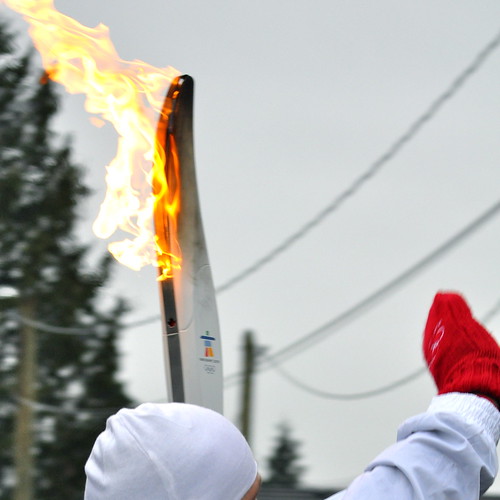
That's the Olympic torch being carried up Willingdon Avenue, about four blocks from my house, on its way through Burnaby and Vancouver to the opening ceremony tomorrow. Two years and a bit from now, maybe I'll get that new driver's license too.
Labels: cancer, death, driving, olympics
10 February 2010
Four eyes
Every few years, I get new glasses, not because my prescription has changed (it's been pretty stable for about a decade), but because my old spectacles simply get old and worn out. This year, I took advantage of a two-for-one sale and got one set of new plastic frames (centre below) and one set of metal ones (right):
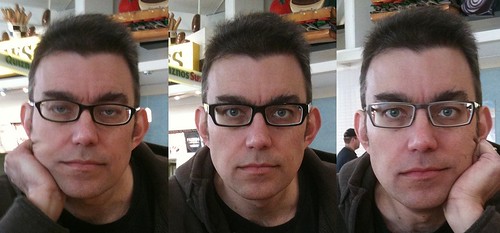
They're not a big change from my old set (left), but I like the new looks, though I'm not sure which of the two I prefer. Back in 2008 when I bought my last set, I wasn't sure I'd survive long enough to need new ones, but here I am. Yay.
Which pair do you prefer?
Labels: cancer, death, ego, glasses
04 February 2010
My tumours have shrunk for the first time ever
 Today I heard something I've never heard before: "your tumours have shrunk." Through all the many different varieties of chemotherapy and radiation and immunotherapy and experimental Phase 1 drug trials I've put myself under during the past three years, only surgery has ever knocked my cancer back. Everything else, at best, kept it at bay.
Until now. Of course this is good news—but that's all relative. The tumours I showed you back in September are still pretty big, but they are measurably smaller than they were in November. And that includes the new ones that had just appeared in the fall. So I still have cancer, a lot of it all over the inside of my chest, but just a little less of it than I did a couple of months ago. As I wrote to some friends, I'm not out of the woods, but at least I'm no longer sinking slowly into quicksand either.
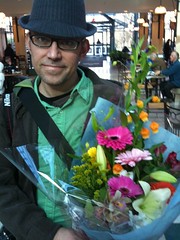
Thus, this afternoon on the way out of the cancer clinic, my wife Air and I smiled a little, held hands, and bought some flowers to put in the house in celebration. Later on we had takeout sushi with the kids. And tomorrow I go back in for more chemotherapy, which I hope will continue to beat the shit out of those metastatic growths.
So I'll be a sleepy, nauseated lump of crap for the next three or four days. A bit of good news doesn't suddenly make things go easily, you see.
Labels: cancer, chemotherapy, love, news, vancouver
01 February 2010
My 13 jobs
This month, February 2010, marks three fricking years since I first went on disability leave for cancer treatment. (And, incidentally, since we got our Nintendo Wii.) This got me thinking about all the jobs I've had in my life, starting back when I was still in high school.
It turns out that I've worked for 13 organizations, if you include my own company when I was freelancing. I did not enjoy every job, but each taught me something:
| Year(s) | Job | Lesson |
|---|---|---|
| 1985? | Graveyard-shift self-serve gas station attendant | Don't be a graveyard-shift self-serve gas station attendant. Also, burnt coffee smells really bad. |
| 1988 | Park naturalist | Science is fun, five-year-olds aren't patient, but summer jobs are a great place to meet your future wife. Also, avoid flipping your canoe. |
| 1989 | Science centre floor staff | Science is fun, but you'll spend most of your time telling people where the bathrooms are. |
| 1990 | Student handbook editor | Choose your fonts carefully, and people never get things in on deadline. |
| 1991 | Student society admin assistant | It's a long way to pick up your printouts across campus when you type them on a mainframe computer. |
| 1991 | English conversation coach | Japanese girls definitely interested in learning English; Japanese boys (who smoke like chimneys), not so much. |
| 1992–1994 | Student issues researcher | Creating your own job is great, but it sure would be nice to have an office with a window. |
| 1994–1995 | Full-time rock 'n' roll drummer | Playing live music onstage is often awesome. Everything offstage, however, usually sucks. |
| 1995–1996 | Magazine advertising assistant | No matter how nice your co-workers, a bad boss can ruin the whole experience. |
| 1996–2001 | Various software company jobs, from developers' assistant to webmaster | Even if you know almost nothing about how to do it, when someone asks you if you want to run a website, it's still worthwhile to say "sure!" |
| 2001–2003 | Freelance technical writer and editor | The paperwork to run your own business is immensely boring. |
| 2001–2003 | Semi–full-time rock 'n' roll drummer | Rock is more fun when you mostly stay in town and get paid better. |
| 2003–2007 | Communications Manager, Navarik | Working with friends can be a good thing, especially when they have good ideas. Oh, and a decent extended-health plan is really, really important. |
In the late '80s, I also helped my friend Chris install alarm systems in people's homes and businesses, but while I got some money from it, it wasn't quite a job in the same way. It was more like when I helped him repair cars and resell them around the same time. Though in those cases, I did learn that I dislike crawling around in fibreglass-filled attics running wires, and that I'm not too fond of all the grease, gunk, and rust involved in auto work either.
Labels: anniversary, band, cancer, editing, ego, memories, navarik, neurotics, nintendo, wii, work, writing
28 January 2010
Searching for the plunger at 1 a.m.
I had another CT scan today, to see whether my current chemotherapy is doing any good to slow or reverse or do something to the ever-expanding tumours in my chest. I'll find out the results, and what that means for my chemo regimen, next week.
In the meantime, following my most recent chemo treatment last weekend, the side effects continue. A relatively new one is that if I haven't eaten for an hour or two, the first thing I pop in my mouth causes the salivary glands on either side of the back of my tongue to ache as they kick in. I can almost feel them pumping. It's not really painful, just bizarre.
And there is the endless fun with my digestive system. Last night I was in the bathroom for nearly an hour, then, when I thought I was done and was brushing my teeth to prepare for bed, suddenly my GI tract decided things needed to clear out from the other end as well, and I puked into the sink.
Next, to top it off, the sink clogged. I stared at it in disbelief for a moment, then searched our closets for the plunger at 1:00 a.m.—and I'm sure glad it worked once I found it. Very pleasant, I must say, especially in my chemo-nauseated state.
I didn't sign up for this. But at least I'm alive to complain about it, and I have a wonderful sleepy wife and puppy to keep me warm once I do get into bed tonight. They should help me sleep very, very well.
Labels: cancer, chemotherapy, ctscan, family, pain
08 January 2010
A funny thing happened to me on the way to the chemo ward
Today is exactly three years since I found out I have cancer. I had it longer than that, at least since the spring of 2006, but that's when I knew. Three years of hell, total hell. So, another cancer post—but that won't be all I write here, just as it hasn't been since January 2007.
Chemotherapy is weird. Not the concept of it, really, which is pretty simple: poison your body with chemicals that try to poison cancer cells more than healthy cells. But being on chemotherapy is weird.
Every combination of chemo drugs is targeted a particular variety of cancer, and every person gets different side effects depending on the drugs and on our own physiology. I've been through numerous rounds of different types of chemo in the past three years. The stereotypes of nausea, weight loss, and hair falling out are true—all too true in some cases, such as when I barfed up my entire breakfast yesterday morning—but they are not universal. I've only had to shave my head once (so far), for instance.
But most chemo regimens have a variety of other, much stranger side effects too. There was that brutal acne I had a couple of summers ago, for instance. The warnings to avoid anything containing grapefruit or starfruit in other instances (though oranges, lemons, limes, and other citrus were fine). Strange black lines developing in my fingernails. Sensitivity to sunlight. Lots of bizarre and nasty intestinal side effects that sometimes had me in the bathroom for three or four hours at a time. And so on.
This time around, I have several different oddball side effects at the same time:
- My skin is remarkably sensitive to cold. On Christmas Eve, some of my family went for a walk for about 20 minutes. The weather was just around the freezing mark, and I was wearing a hat, gloves, and a scarf wrapped around my face. But when we got back to my aunt and uncle's house, the tip of my nose and my fingers felt almost frostbitten, burning until they warmed up. I have to be careful simply taking cold drinks out of the fridge.
- Speaking of which, I can't drink cold liquids either. For instance, I had some orange juice out of the fridge last week. No one but me in our house likes juice with pulp, so I was surprised when this one was full of pulp. Except it wasn't—my mouth and throat were reacting to the cold and making it feel like the drink was full of globs of pulp, even though it was clear. Then it hurt.
- The knuckles on both my hands are dry and the skin has darkened. When I put my hands palm down, they have stripes of brown pigment across the fingers.
- Cuts and bruises take longer to heal. I drew blood during some Ikea furniture disassembly more than a week ago, and it still hurts as the scab seals up.
- I have nausea, but other than when I'm actually on the chemo, it's wildly unpredictable. That breakfast I lost yesterday? A minute before I vomited, I felt fine. Same a minute later. And one of the only things I can eat no matter how I feel is Cheese Pleesers—those extruded cheese puff snacks.
- Then there are my feet. They're not exactly sore, but my soles are extra-sensitive, almost as if they have blisters on them. Sometimes. Most often I don't notice it, but I can't stand having a bathmat in the tub when I shower because it irritates my feet, and I wear socks pretty much all the time otherwise, even to sleep.
There may be more symptoms coming, I don't really know. But it's weird. And exhausting.
Labels: anniversary, cancer, chemotherapy, pain
05 January 2010
Death, pessimism, and realism
I've mused about death often enough on these blog pages, especially since I developed cancer in 2006 and it spread into my lungs since 2007, and now that it's gotten worse. I've also discussed my atheism and how that affects my attitude about death.
Some people think that without any belief in an afterlife, or a soul, or Heaven, death for me must be a scarier or emptier than for those who believe in such things—that somehow I must face death without comfort or solace. But that's not true. I have tried to explain it before, but yesterday blogger Greta Christina did a better job. She calls it "the difference between pessimism and realism," and it's worth a read, whatever you believe.
Labels: cancer, controversy, death, religion
04 January 2010
First post of 2010, four days in
Okay, I'm back. I slept almost solidly for three days after chemotherapy, and right now I'd say I'm feeling about 60%. Maybe less. It depends on how well the Gravol is working at any particular moment.
My mom made some soup, and I think I will eat it now. End of report.
Labels: cancer, chemotherapy, family, food
07 December 2009
That weekend suuuuuucked
I'm back in the world of the living again. It was a pretty rough weekend, I tell you. I had chemo like this back in 2007 and 2008, but I don't think I had all three of these chemicals (oxaliplatin, leucovorin, and 5-FU) all together previously, and the infusion bottle I had from Friday to Sunday at home also dispensed more of the 5-FU in it than I'd received before, so I was getting a larger dose than I'd encountered in earlier rounds of chemo.
So, in short, it suuuuuucked. I didn't actually throw up, but I basically doped myself up with prescription anti-nauseants and Gravol so that I slept most of the weekend, and felt like death when I was awake. I was out of commission and useless to my family for three full 24-hour days at least. It was only this morning that I felt anything like normal again, so I'll rest today and may get back to some sort of functional life until I do it again in a couple of weeks.
Chemo is no fun, that's for sure. I recommend avoiding cancer just so you can not have chemotherapy, entirely aside from all the other reasons.
Labels: cancer, chemotherapy, family, pain, sleep
03 December 2009
Back on the train
Today I saw my oncologist to find out about my next round of cancer treatment, but even before that, the chemo ward called me yesterday and said they'd had a wait-list cancellation. My first appointment tomorrow is, Friday, at 2 p.m.
So by tomorrow at this time, I may feel like throwing up for two or three days (or not—some new anti-nausea drugs are now available). On the other hand, I'm ready to get the hell started. This regimen is similar to some of the chemotherapy I've had before, so I have a decent idea what to expect. Unfortunately, it's not much fun.
I'll post more information as soon as I feel like it.
Labels: cancer, chemotherapy, fear
27 November 2009
Oh fuck
I found out yesterday that there are new cancer tumours in the centre of my chest—several of them, each 2 to 3 cm in size, near where my lungs meet. They showed up on the CT scan I had Monday, and they were not there on the scan in September. That means they've grown quickly, which is fucking bad news.
After meeting with my doctors at the B.C. Cancer Agency yesterday, I've stopped using cediranib, the drug that had kept my existing lung tumours growing only very slowly over the past year. I'll likely return to more conventional and aggressive chemotherapy again sometime in the next couple of weeks.
Since I found out about my cancer almost three years ago, it has never been in remission. Some people who read this blog or know me in person have, mistakenly, thought otherwise, because I've often appeared in good health.
But my cancer has never shrunk, only slowed down. It started in my large intestine, then spread to my lungs from there. The bowel tumours came out with surgery in 2007—otherwise I would probably have died later that year. But the lung metastases can't really be tackled with surgery or radiation, because there are too many, too widely spread, and too deep in my body. Chemo is the best option.
This is serious. Faster-growing metastatic tumours near my lungs, my heart, my trachea, and my esophagus are dangerous and potentially lethal. In addition to attacking them with chemo, in a few months there may be some clinical trials of MEK inhibitor drugs available to me, but that's not certain. Those experimental medications operate on the kinase cascade metabolic pathway that helps cancer cells grow. So we'll see about those too.
New, fast-growing cancer is not what anyone wants in my body, but I can't say it's unexpected, or a genuine surprise. This is how cancer often goes. Treatments work, sometimes better, sometimes worse—and then sometimes they stop working. It's always a fight, and one I might lose.
My wife and children and parents and family and friends are sad. My head is swimming with thoughts of all sorts. Time to walk into the unknown future again.
Labels: cancer, chemotherapy, death, family, fear, friends, pain
18 November 2009
My interview last week on CBC TV
Last week, reporter Theresa Lalonde from CBC interviewed me at my house about how people can plan for what to do with their online presence after they die. The TV video report is now online, and soon I'll post the audio radio versions she did as well.
The topic is similar to a much longer interview I had with Nora Young at CBC's "Spark" last year. There are basically two components to the whole enterprise: figuring out which online activities of yours to shut down and how, and figuring out which ones to keep going and how.
Labels: cancer, cbc, death, radio, television, video
13 November 2009
Step 1: put your pup in the box
It took a little over ten days, but we found ourselves a puppy! (I've posted a short movie.)
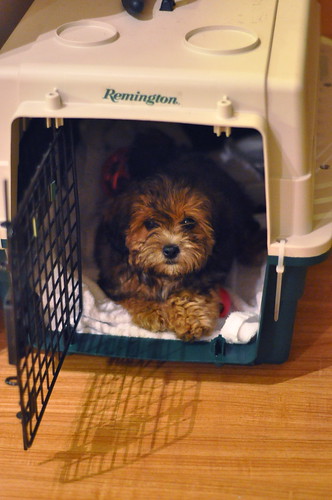
We've called her Lucy. She was born around August 25, 2009, and is half shihtzu and half toy poodle, making her a shih-poo, or, as I prefer the term, shpoo. Housebreaking Lucy appears to be the first challenge, but she has adjusted to our house and family shockingly fast otherwise. She is also surprisingly quiet for a little dog, which is nice.
She even kept me company in the bathroom during one of my bouts of intestinal side effects from my cancer medicine today.
Oh yeah, I also finally got an iPhone yesterday. But it doesn't seem like a particularly big deal now.
Labels: cancer, family, home, iphone, pets
08 November 2009
What comes and goes
I've been a little sick this week. Not with an infection, but with what I think are side effects both from my cancer medication and from the H1N1 and seasonal flu shots I had last week. My right arm, where the H1N1 vaccine went in, is still sore like I've been punched. I've had periodic mild fevers all week, I've slept a lot, and the intestinal symptoms I usually have are more pronounced than usual.
I assume it's the combination of side effects that have made me a bit more ill, but it's hard to know. My cancer is growing very slowly in my lungs, but it's not shrinking. So I can expect that eventually it, or the effects of long-term therapies, or both together, will make me weaker and give me more pain. I don't think that's happening now. I expect and hope that as my immune system builds antibodies to the two flu strains (something that takes a week or two), I'll perk up a little.
I can't be certain. I always have some fear that a new weakness or pain I develop won't get better. The fear itself can be tiring, either at its usual low level or when it flares up. But that too is something I've become used to. Fear, like pain, like fatigue, comes and goes.
Some other things, I have discovered, do not. They stay. Love is one.
Labels: cancer, chemotherapy, fear, love, pain
04 November 2009
Family and flight
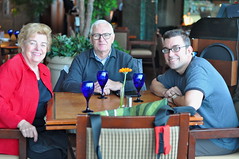 Today my parents flew to Frankfurt for a couple of weeks in Germany. They're staying with friends in Bad Zwischenahn, as well as visiting some of my father's relatives in Berlin, where he was born and lived until 1955. They had enough airline points to travel First Class, which I don't think they've ever done before.
Their trip is shorter than they had initially planned. My parents live next door to us in our duplex, the same house where I grew up, and they offer us a lot of support, especially with the kids, and particularly since I've been ill over the past few years. I told them a few weeks ago that their initial trip seemed too long to me. It was hard to admit that—I'm 40 years old and don't like having to depend on my parents again.
Yet it wouldn't have been fair not to ask. I have a lot of side effects from the cancer medications these days, and while we can handle not having my mom and dad nearby for a week or two, longer than that is likely to put a lot of pressure on my wife, and my daughters, when I'm not feeling well.
The three of us, Mom, Dad, and I, drove to the airport today, and had a fancy lunch in the Fairmont Hotel overlooking the jetway. I dropped them at the gate, then walked around the airport a bit and watched the planes some more. Then I drove home and spent an hour in the bathroom, as happens these days.
I'm sure they'll have a fun trip, and I'm glad they could go. I'll be happy to pick them up when they return too.
Labels: airport, cancer, europe, family, travel
01 November 2009
Dog in the family?
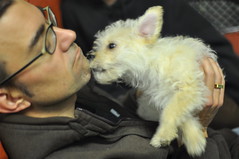 I've never owned a dog, not even as a child. I've had fish (we have them now), and back in the early '90s, my roommates and I had a smart black 24-toed cat named Guildenstern, who died too young and is buried in the back yard. But never a dog.
We're probably going to get a dog. It has to be hypoallergenic, since my wife Air is allergic to most furry things. But our experience with a couple of friends' dogs (including dogsitting Podcast Puppy) has shown us that a few breeds, usually poodle crosses, don't set off her immune system.
I've always been reticent to adopt a dog because our family likes to travel, but with my cancer, I can't and don't travel very far these days, and with my wife at work and the kids at school, I'm often home by myself. The right dog would make a good companion for me, and get me out of the house more. I need that. And most dogs seem to like me. Plus caring for a dog is something new to learn.
I've warmed considerably to the idea. We visited some puppies today. It probably won't be long. I'll keep you posted.
Labels: cancer, family, home, pets, travel
22 October 2009
Spin my ribcage
Derived from the same CT scan of my body taken a few weeks ago is this 3D movie, also made with the open-source OsiriX software:
You can clearly see my portacath, which showed up just as well as my ribs. Freaky.
Labels: cancer, chemotherapy, ctscan, geekery, photography, science, software, videogames
20 October 2009
See my cancer
Here, take a look at this extremely cool and scientifically amazing picture:
That's me, via a few slices from my latest CT scan, taken at the end of September 2009. I opened the files provided to me by the B.C. Cancer Agency's Diagnostic Imaging department using the open-source program OsiriX, giving me my first chance to take a first-hand look at my cancer in almost a year. Before that, the I'd only seen my original colon tumour on the flexible sigmoidoscopy camera almost three years ago.
I've circled the biggest lung tumours metastasized from my original colon cancer (which was removed by surgery in mid-2007). You can see the one in my upper left lung and two (one right behind the other) in my lower left lung. There are six more tumours, all smaller, not easily visible in this view. I'm not a radiologist, so I couldn't readily distinguish the smallest ones from regular lung matter and other tissue. Nevertheless, now we can all see what I'm dealing with.
These blobs of cancer have all grown slightly since I started treatment with cediranib in November 2008. To my untrained eye, the view doesn't look that different from the last time I saw my scan in December of that year, which is fairly good as far as I'm concerned. Not as good as if they'd stabilized or shrunk, but better than many other possibilities.
Labels: cancer, chemotherapy, ctscan, geekery, photography, science, software, video
18 October 2009
Sunday night
It's Sunday night and I'm not sleepy. Well, I am, but I can't sleep, don't really want to yet. Everyone else in the house is down for the count until morning. I've always enjoyed this time, taking me back to being an only child alone with my thoughts—except my wonderful wife is breathing beside me in bed, which is much better, and endlessly comforting.
But tonight's not happy, or sad. It just is. Every day is a fight. Every. Fucking. Day. And every night too. Not a fight with a person, but with my own cells, useless greasy tissues that don't belong where they're growing in my lungs. I never know how much of my pain and fatigue is from them, and how much from the punishing medicine that slows the rate of cancer cell division inside me.
I spent a lot of this weekend in the bathroom. I don't know if that's a pattern yet, or just a rough few days of side effects. (But not as rough as some have been.) I cooked a pretty nice tikka masala dish tonight, and my wife brought home a lemon meringue pie for dessert. Our dinner with the kids at the kitchen table was my best part of Sunday.
Sometimes, like now, I don't want to sleep because I don't know what I'll be like when I wake up. Will I feel better, worse, the same? I can't predict, but at least I'm confident I will wake up. Will I sleep well, and rise rested, or toss and turn? Or will I be in the bathroom again, perhaps for hours? I don't really know.
I try to live day by day, but you have to plan something, even if your plans fall through. I have a few plans for tomorrow, and maybe I'll get to some of them. Or at least one. Or, just maybe if tonight goes poorly, none. These are my days and nights, more than three years after I developed cancer, and almost three years after I found out about the first (but not the worst) of it.
A fight. Every. Fucking. Day. And night. And more tomorrow. Time to sleep now, I think. To be ready.
Labels: cancer, chemotherapy, family, fatigue, pain
27 September 2009
The scramble
I played the gig last night at the tony private Shaughnessy Golf and Country Club, covering percussion, some drumming, background vocals, and (the first time for a performance that long) rhythm guitar. I was a bit of mess—my health was fine, but the three instrumental roles, plus singing, include lots of mental and physical gymnastics, so I usually felt like I was scrambling along a bit behind the others. I did okay, and I had a lot of fun.
It was also the first time this particular band lineup had worked together. We have another show next Saturday, and I expect I'll do a bit better, particularly since I'll improve my sense of what I should play on different songs. I also think a week is about the right amount of recovery time. Thanks to Jeremy, Dave, Rose, Sebastien, and Christian for having me sit in for these two Saturdays. It's been a nice break during my ongoing cancer-treatment nastiness.
Labels: band, cancer, friends, music, vancouver
14 September 2009
Book Review: Say Everything
 It's a bit weird reading Say Everything, Scott Rosenberg's book about the history of blogging. I've read lots of tech books, but this one involves many people I know, directly or indirectly, and an industry I've been part of since its relatively early days. I've corresponded with many of the book's characters, linked back and forth with them, even met a few in person from time to time. And I directly experienced and participated in many of the changes Rosenberg writes about.
The history the book tells, mostly in the first couple of hundred pages, feels right. He doesn't try to find The First Blogger, but he outlines how the threads came together to create the first blogs, and where things went after that. Then Rosenberg turns to analysis and commentary, which is also good. I never found myself thinking, Hey, that's not right! or You forgot the most important part!—and according to Rosenberg, that was the feeling about mainstream reporting that got people like Dave Winer blogging to begin with.
Rosenberg's last book came out only last year, in 2008, so much of what's in Say Everything is remarkably current. He covers why blogging is likely to survive newer phenomena like Facebook and Twitter. And he doesn't hold back in his scorn for the largely old-fashioned thinking of his former newspaper colleagues (he used to work at the San Francisco Examiner before helping found Salon).
But then I hit page 317, where he writes:
...bloggers attend to philosophical discourse as well as pop-cultural ephemera; they document private traumas as well as public controversies. They have sought faith and spurned it, chronicled awful illnesses and mourned unimaginable losses. [My emphasis - D.]
That caused a bit of a pang. After all, that's what I've been doing here for the past few years. It hit close to home. Next, page 357:
For some wide population of bloggers, there is ample reason to keep writing about a troubled marriage or a cancer diagnosis or a death in the family, regardless of how many ethical dilemmas must be traversed, or how trivial or amateurish their labours are judged. [Again, my emphasis - D.]
Okay, sure, there are lots of cancer bloggers out there. I'm just projecting my own experience onto Rosenberg's writing, right? Except, several hundred pages earlier, Rosenberg had written about an infamous blogger dustup between Jason Calacanis and Dave Winer at the Gnomedex 2007 conference in Seattle.
The same conference where, via video link, I gave a presentation, about which Rosenberg wrote on his blog:
Derek K. Miller is a longtime Canadian blogger [who'd] been slated to give a talk at Gnomedex, but he’s still recovering from an operation, so making the trip to Seattle wasn’t in the cards. Instead, he spoke to the conference from his bed via a video link, and talked about what it’s been like to tell the story of his cancer experience in public and in real time. Despite the usual video-conferencing hiccups (a few stuttering images and such), it was an electrifying talk.
Later that month, he mentioned me in an article in the U.K.'s Guardian newspaper. When he refers to people blogging about a cancer diagnosis, he doesn't just mean people like me, he means me. Thus I don't think I can be objective about this book. I think it's a good one. I think it tells an honest and comprehensive story about where blogging came from and why it's important. Yet I'm too close to the story—even if not by name, I'm in the story—to evaluate it dispassionately.
Then again, as Rosenberg writes, one of blogging's strengths is in not being objective. In declaring your interests and conflicts and forging ahead with your opinion and analysis anyway, and interacting online with other people who have other opinions.
So, then: Say Everything is a good book. You should read it—after all, not only does it talk about a lot of people I know, I'm in it too!
Labels: blog, books, cancer, gnomedex, history, review, web
03 September 2009
The power of words
 My last post (and the delay since I wrote it) emerged from worry and fear—which was perfectly reasonable, but has abated today. I'll explain.
A couple of weeks ago, while my wife Air and I were at Gnomedex in Seattle, I took a break from my current cancer medication for a couple of days to avoid nasty intestinal side effects during the conference. That's nothing unusual: I do the same every month at some point. But this time, as my digestive system slowed down, I got some strange pains in the middle of my back during the night. They kept me awake until I discovered that sitting up in bed reduced them, and I could sleep. They disappeared once I resumed the pills (and the poopfests that result).
But the pains came back, more frequently, sometimes waking me up in the night, or keeping me from getting to sleep. Eventually they appeared during the day. The feeling, sharp and deep, reminded me of the bowel blockage I had last year, which landed me in hospital for a few days—only (luckily) about 10% as painful this time. But nothing was blocked, believe me. And that lack of blockage provided regular relief, as the pains moved around and then went away, to come back another time.
Having pain that came and went, but always started just below where I know there are tumours growing (slowly) in my lungs was—needless to say—disconcerting. Fearsome. Perhaps even terrifying. So I was nervous when I visited the B.C. Cancer Agency today for my regular monthly checkup.
But two doctors and a nurse all think, given my long-winded explanation of what was going on and how the pain behaved, that it's a fairly simple digestive problem, likely treatable with something as simple as Maalox Plus and, at most, some Tylenol with codeine. My intestines have certainly been through the wringer over the past couple of years, and there could be adhesions or scar tissue in there—or they could simply be misbehaving because of what the cediranib I'm taking now inflicts on them.
Anyway, there's no reason to think it's the cancer getting substantially bigger. My kidneys aren't failing. There's no blood clot or heart attack going on. So now, while I'm uncomfortable some of the time, the pain is no longer terrifying. Behold the power of comforting words.
30 August 2009
Old man, look at my life
 I've come to realize something in the last few days. My cancer treatment drags on, keeping me alive but not really getting me better. I continue to manage my diabetes and live with an artificial IV port in my chest. I take lots of pills and shots, get medical tests, and see doctors all the time. I can't safely travel very far.
More to the point, I hurt, and I'm tired. Many parts of my body simply don't work the way they're supposed to. Most of the time, I'm nothing close to genuinely well. I may never return to my great job. I've been like this in some form or another for more than two and a half years.
So here's what I realized. I'm a 40-year-old man whose body has become much older. I'm a youngish guy in an oldish container. There are plenty of people three decades beyond my age—including my own parents—who feel better than I do, and can do more. And the hard part (for all of us) is knowing there's a good chance they'll live longer than me too.
For the vast majority of human history, living to age 40 was an achievement in itself. Even a hundred years ago, Type 1 diabetes like I have was a death sentence too—I would have died in my early 20s, before I had a chance to marry my wonderful wife or have two great children. I'm glad I've had those chances.
If I were (for instance) 75 years old now, it would be easier to accept what cancer has done to me, and to acknowledge that living (for example) another five years would be a pretty good achievement. I'm trying to think more like that—not to be fatalistic, but to be pragmatic, to know that while I'll keep fighting, without radical new treatments or some very good luck, it's probably a losing battle. But that's not a failure.
I'm sitting on the back porch in the sun, drinking a coffee. In a few minutes I'll help my kids make some cake. It's a good life.
Labels: age, cancer, death, diabetes, family, navarik, pain
25 August 2009
Gnomedex 2009 day 2 and wrapup
 Gnomedex 9 ended several days ago, but I needed to think about it a bit before writing my overall impressions. Each year (I've been part of five Gnomedexes now) has a different vibe, and this one was a bit hard to pin down.
It was certainly less confrontational. For whatever reason, none of the previous web-heavy-hitter attendees—Dave Winer, Steve Gillmor, Sarah Lacy, Jason Calacanis, Mark Canter, Doug Kaye, Adam Curry, et. al.—was there this time, which made for less high-level arguing (or grandstanding). And while many of the sessions were fascinating, I didn't get my mind blown the way some of last year's talks did to me.
I think, perhaps, it was not quite as inspiring, but more fun. Notes and quotes:
- "Anybody still use Second Life? One person? How's it workin' for you?" - Chris Pirillo (At Gnomedex 6.0 in 2006, Second Life was the Current Big Thing. Not anymore.)
- "Sock Summit is Gnomedex for sock knitters. Thousands of women—and one guy —descended on Portland." - Beth Goza (Something I didn't know about knitters: they go on "yarn diets" to stop spending money on new yarn, i.e. fight the addiction.)
- "If anyone here is a mathematician, I made this up!" - Micah Baldwin
- "We're not geeks, but we're really really trying hard to be." - Leah Nelson
- In a brief appearance onstage, I mentioned a photo of the planet Mercury my dad took in 2006, and an Astronomy Picture of the Day of the International Space Station taken in a similar way.
- Mark Horvath said that, "The average homeless person is America is nine years old." But it didn't take long to find out that's not true. Regardless, the story of James (who isn't nine, and who came onstage too) was compelling, and we raised some money for him.
- The un-seeable space of the Internet makes us all astronaut-style cyborgs in its space, according to Amber Case. And these days, you break your cellphone and you say, "Crap, now I can't hear all the way to Egypt at the touch of a button anymore." Also, "People have enough trouble with driver's ed right now, so, uh, jetpacks?"
I was also glad to have a hug with Drew Olanoff, who was diagnosed with cancer only three months ago and has turned it into a worldwide fundraising effort already. I Blame Drew's Cancer that I didn't manage that when I found out about my cancer in 2007.
On our last night in Seattle, Air and I spent the dinner hour pounding open steamed crab legs with little wooden hammers, then had a drink and watched the Moon set behind a sailboat at our hotel. The next morning as we left the hotel driveway, we saw this:

I'd say it was worth going.
Labels: cancer, conferences, friends, geekery, gnomedex, seattle
19 August 2009
Proud to be her man
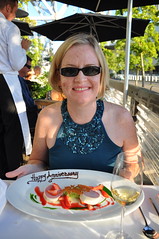 As of today, August 19, 2009, my wife Air and I have been married 14 years. As on our wedding day, the weather was Amazing Vancouver Summer last evening, our Anniversary Eve: mid-20s Celsius, sun glinting off the water. The kind of weather which impels people to spend thousands of dollars to visit. We went to C Restaurant on False Creek, where we'd last dined exactly three years ago, just before our 11th anniversary.
You know that "in sickness and in health" thing? Don't take it lightly—we've had more than our share of that seesaw over the past decade and a half. Even yesterday, it was touch-and-go whether we'd have to cancel our reservation.
You see, I was tuckered out after moving some of the kids' furniture all afternoon, and feared the onset of the dreaded chemo-induced Jurassic Gut. But with the help of some medicine, the prospect of an excellent and relaxing meal, the sheer fabulousness of looking at my wife, and a lot of willpower and positive thinking, I not only made it downtown, but was symptom-free throughout dinner and the whole trip home. (And then everything got rolling once we returned, but I won't give you details...)

The restaurant provided some little extras for us: custom chocolate script on our dessert plate, plus post-dinner ice wine on the house. We spent a leisurely two and a half hours eating wonderful, creative seafood, and we held hands to look out across the water, making occasional snarky comments about passersby on both land and sea. When we told the waiter we were celebrating 14 years, he asked, "Did get married when you were teenagers?" That's a nice compliment, since we were both 26 back then.
Air and I have been happy and sad, content and afraid together. I'm not as strong or healthy as I used to be, and I'm greyer and far more scarred and broken. But I am proud to be her man, and I'll do my damnedest to be here for as many more anniversaries as I can.
Labels: anniversary, cancer, chemotherapy, food, love, oceans, restaurant
02 August 2009
Wakeup time
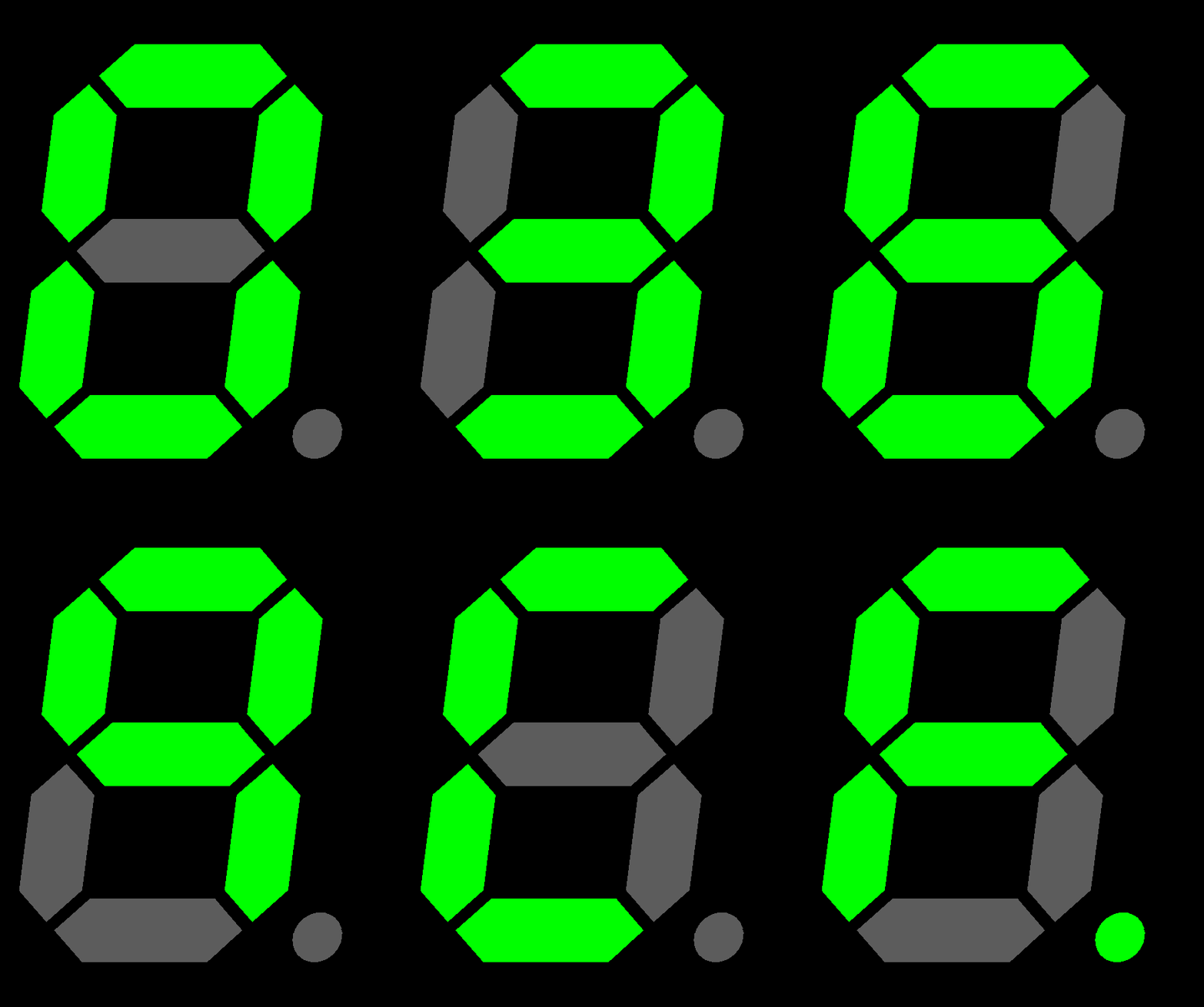 A couple of days ago, I woke up and looked at my clock radio, reading 1:22. That surprised me—I didn't think I'd slept in till well in the afternoon. But it turned out I was just at a funny angle, and couldn't read the top of the first seven-segment digital numeral. It was actually 7:22 a.m., so I went back to sleep and woke up a couple of hours later instead.
Then there was today. My current cancer medication causes somewhat unpredictable intestinal side effects. Last night included some of the worst. I was in the bathroom from midnight until just before 2 a.m., then again from 4 to 6, then up and down every half an hour or so until at least 9:30 a.m. In other words, I had perhaps three hours of sleep before morning.
So, when things had calmed down enough, I feel asleep again. Guess what time I woke up? 1:22 p.m., for real this time.
Labels: cancer, chemotherapy, fatigue, pain, sleep
28 July 2009
Making stories, showing off (for Raul's Blogathon)
This is a re-post of the guest entry I wrote for Raul's Blogathon on Saturday.
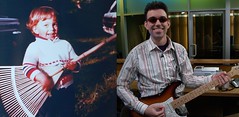 Here's a story. Two years ago this week, I weighed 145 pounds, about 70 pounds less than I do now. I looked like I'd been in a PoW camp, pale and skeletal. I'd just left St. Paul's Hospital, where I'd been for close to a month after major cancer surgery and an intestinal blockage.
By October I'd gained back 30 of those pounds. Within a year I'd taken a bunch more chemotherapy, lost my hair and grown it back, and had terrible chemo-induced acne. A year after that, the cancer is still here, but I'm fighting it, and I feel pretty good. End of story, for now.
We all grow up making stories—when we're kids, we call it playing, whether it's using an infant mobile or a video camera. And our stories are best when we make them for others, or with them. Unfortunately, many of us become unused to playing, thinking it childish. We grow up terrified of giving speeches, or we write our thoughts only in diaries instead of for reading. We become shy.
For whatever reason, that didn't happen to me. I've been passionate about many things in my 40 years—computers, photography, public speaking, music, making websites, writing and language, science and space, commuting by bicycle, building a life with my wife and family—but when I took at them all, each one is really about making stories for others. Or, as my wife succinctly pointed out, about showing off. I'll admit to that.
Some examples, in no real order:
- Helping put together a school newspaper in sixth grade (or high school, or university).
- Donning a smoking jacket and hand prosthetic to play Captain Hook on the elementary school stage.
- Setting my daughters up with blogs and email addresses before they each turned ten.
- Posting photographs to MacDesktops in the late '90s and photo.net a few years later.
- Playing in a band in crappy bars or luxury New York hotels.
- Editing my high school yearbook (with others) and the UBC student handbook (by myself).
- Teaching courses about Microsoft Word.
- Talking about my cancer on the radio.
- Talking about geeky stuff on TV.
- Recording songs and giving them away for free.
- Helping my wife Air put together her podcast.
- Uploading thousands of pictures and videos to Flickr.
- Crafting obscure technical documents to make them understandable.
- And of course blogging and blogging and blogging for close to nine years.
I've done many of these things for no money (and some for lots of money), but for almost all of them, I wanted other people to know.
Okay, yes, I wanted to show off. Is that healthy?
For me, on balance, I think so. Whether for my jobs or my hobbies, being a ham and wanting others to see and appreciate what I do prods me to make those stories good, and useful. Humans are natural tellers of stories, and we enjoy anything presented in a story-like way. So I've tried to make all of those things in the form of a story. Whether a discussion of evolutionary biology, a fun rockabilly instrumental, a bunch of rants about PowerPoint, or a pretty photograph (or yes, even the instruction manual to install a wireless cellular modem in a police car), I want it to generate a story in your mind.
Stories don't always have an obvious structure. They don't necessarily go in predictable directions, or have a moral or meaning. I certainly didn't see it coming when all this cancer stuff from the past two and a half years happened. But I've been able to make it a story that other people can read, understand, and maybe find helpful. So too with my other passions.
So whatever you're trying to do, whatever hobby or job or habit you have, if you want to share it with others, try to craft it like a story—short or long, visual or auditory, but something that flows. Show it off. That, it seems, is what I like to do.
Derek K. Miller is a writer, editor, web guy, drummer, photographer, and dad. Not in that order. He's been blogging at penmachine.com since 2000, and has been on medical leave from his position as Communications Manager at Navarik Corp. since 2007. His wife and two daughters have put up with his show-offishness way longer than that.
Labels: band, blog, cancer, charity, editing, friends, music, photography, vancouver, writing
14 July 2009
Links of interest 2006-07-05 to 2006-07-13
Yup, still on a blog break. So, more of my selected Twitter posts, newest first:
- Vancouver to Whistler in one minute (okay, I cheated):
- We're in the mountains, but in a civilized way. Pool/hot tub, grocery store across the street, Wi-Fi. But, uh, there is mountain weather.
- Super-duper stop-motion movie with 60,000 photo prints (ad for Olympus, via Lisa Bettany and Photojojo). Chris Atherton points out that this follows Wolf and Pig.
- Okay camera nerds, here's some rangefinder pr0n for you.
- The stereotypically blingtastic (and boobtastic) video diminishes Karl Wolf's tolerable version of Toto's "Africa." (And I'm no Toto fan.) It's like a live-action Hot Chicks with Douchebags. Yes, the choirboy harmonies are actually kind of charming, but he's going P-Diddy on it in the end.
- In the storage closet, my kids found something of mine from 1976 that is EVEN GEEKIER than my U.S.S. Enterprise belt buckle:
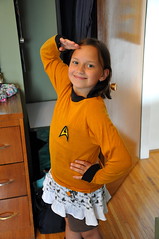
Red shirts were available back then, as well as the blue Mr. Spock style, but I chose Kirk. Of course. - The only sounds I can hear right now: the dishwasher, the fan in the hallway, and the birds in the trees outside the window.
- During my biology degree, Platyhelminthes was a favourite organism name. Now there's a plush toy! (With 2 heads!!)
- When I used to busk with the band, our biggest victories were scaring away the holy rollers across the street (we got applause).
- Neat. When a ship is built, here are the differences between milestones: keel laying, christening, commissioning, etc.
- AutoTune the News #6. Even more awesome.
- Picked up kids from Aldergrove camp. Sadly, there was a terrible accident on the Port Mann Bridge. We took a long Langley/Surrey/New Westminster detour.
- Google's changing culture. Point: Google now has more employees than Microsoft did at launch of Windows 95.
- Time lapse: 8 hours from my front window in about 1 min 30 sec, made with my new Nikon D90 and free Sofortbild capture software (and iMovie):
Something like John Biehler's Nikon Coolpix P6000 is better for timelapse long term; the D90's mechanical shutter, which is rated for 100,000 uses, would wear out in less than 6 months if used for time lapse every day. P.S. Andy Gagliano pointed to a useful Macworld podcast about making time-lapse movies. - Depressing: most Internet Explorer 6 users use it at work, because they're not allowed to use another browser.
- These Christopher Walken impressions are way funnier than I expected.
- The way monkeys peel a banana shows us we've all been doing it the needlessly hard way all these years.
- Um... hot!
- Most appropriate Flash cartoon ever?
- Drinking whisky and Diet Dr. Pepper, watching MythBusters. Pretty mellow.
- A good photo is "not about the details or the subject. It's what your subconscious pulls out of it all without thinking."
- Just picked up another month's supply of horrible, nasty, vile, wonderful, beautiful, lifesaving anti-cancer pills. Thanks, Big Pharma Man.
- My wife tells me she's discovered a sure-fire tip for a gal to attract quality guys in public: carry a huge SLR camera over your shoulder.
- "For the great majority [...] blogging is a social activity, not an aspiration to mass-media stardom."
- Just talked to younger daughter (9) for first time after three days at summer camp. She's a little homesick, but having fun.
- I took a flight over a remote landscape:
- The 50 worst cars of all time (e.g. "The Yugo had the distinct feeling of something assembled at gunpoint").
- I haven't seen either Transformers movie, but that's okay, I saw this.
- Dan Savage: cheating on your spouse should now be known as "hiking the Appalachian Trail." Good point in the article too.
- You can still buy a station wagon with fake wood paneling!
- Train vs. tornado. It does not end well. Watch without fast-forward/scrubbing for maximum tension.
- Just lucked into a parking spot on Granville Island. Time for some lunch.
- Sent the kids off for a week of horse-riding camp today. Wife Air and I had sparkling wine in the garden. Vewwy vewwy quiet around here.
- Just sorted a bunch of CDs. Still several discs missing cases, and cases missing discs. I feel like a total '90s throwback.
- Rules of photography (via Alastair Bird).
- When did the standard Booth Babe uniform become cropped T-shirt and too-short schoolgirl kilt?
- Listening to "Kind of Blue." It's been awhile.
- "A two-year old is kind of like having a blender, but you don't have a top for it." - Jerry Seinfeld (via Ryan).
Labels: audio, biology, blog, cancer, chemotherapy, family, flickr, geekery, google, microsoft, movie, music, oceans, photography, sex, startrek, transportation, video, whistler
28 June 2009
Links of interest 2006-06-21 to 2006-06-27
While I'm on my blog break, more edited versions of my Twitter posts from the past week, newest first:
- My wonderful wife got me a Nikon D90 camera for my 40th birthday this week. I'm thinking of selling my old Nikon D50, still a great camera. Anyone interested? I was thinking around $325. I also have a brand new 18–55 mm lens for sale with it, $150 by itself or $425 together. I have all original boxes, accessories, manuals, software, etc., and I'll throw in a memory card, plus a UV filter for the lens.
- Roger Hawkins's drum track for "When a Man Loves a Woman" (Percy Sledge 1966): tastiest ever? Hardly a fill, no toms, absolutely delicious.
- Thank you thank you thank you to everyone who came to my 40th birthday party—both for your presence and for the presents. Photos from the event, held June 27, three days early for my actual birthday on Tuesday, are now posted (please use tag "penmachinebirthday" if you post some yourself).
- I think Twitter just jumped the shark. In trending topics, Michael Jackson passed Iran, OK, but both passed by Princess Protection Program (new Disney Channel movie)?
- AT&T (and Rogers, presumably) is trying to charge MythBusters' Adam Savage $11,000 USD for some wireless web surfing here in Canada.
- After more than 12 years buying stuf on eBay, here's our first ever item for sale there. Nothing too exciting, but there you go.
- Michael Jackson's death this week made me think of comparisons with Elvis, John Lennon, and Kurt Cobain. Lennon and Cobain still seemed to have some artistic vitality ahead of them. Feel a need for Michael Jackson coverage? Jian Ghomeshi (MP3 file) on CBC in Canada is the only commentator who isn't blathering mindlessly. But as a cancer patient myself, having Farrah Fawcett and Dr. Jerri Nielsen (of South Pole fame) die of it the same day is a bit hard to take.
- Seattle's KCTS 9 (PBS affiliate) showed "The Music Instinct" with Daniel Levitin and Bobby McFerrin. If you like music or are a musician, it's worth watching, even if it's a bit scattershot, packing too much into two hours.
- New rule: when a Republican attacks gay marriage, lets assume he's cheating on his wife (via Jak King).
- The blogs and podcasts I'm affiliated with are now sold on Amazon for its Kindle e-reader device, for $2 USD a month. I know, that's weird, because they're normally free, and are even accessible for free using the Kindle's built-in web browser, so I don't know why people would pay for them—but if you want to, here you go: Penmachine, Inside Home Recording, and Lip Gloss and Laptops. Okay, we're waiting for the money to roll in...
- Great speech by David Schlesinger from Reuters to the International Olympic Committee on not restricting new media at the Olympics (via Jeff Jarvis).
- TV ad: "Restaurant-inspired meals for cats." Um, have they seen what cats bring in from the outdoors?
- I planned to record my last segment for Inside Home Recording #72, but neighbour was power washing right outside the window (in the rain!). Argh.
- You can't trust your eyes: the blue and green are actually the SAME COLOUR.
- Can you use the new SD card slot in current MacBook laptops for Time Machine backups? (You can definitely use it to boot the computer.) Maybe, but not really. SDHC cards max out at 32GB (around $100 USD); the upcoming SDXC will handle more, but none exist in Macs or in the real world yet. Unless you put very little on the MacBook's internal drive, or use System Preferences to exclude all but the most essential stuff from backups, then no, SD cards are not viable for Time Machine.
- Some stats from Sebastian Albrecht's insane thirteen-times-up-the-Grouse Grind climb in one day this week. He burned 14,000+ calories.
- Even though I use RSS extensively, I find myself manually visiting the same 5 blogs (Daring Fireball, Kottke, Darren Barefoot, PZ Myers, and J-Walk) every morning, with most interesting news covered.
- I never get tired of NASA's rocket-cam launch videos.
- Pat Buchanan hosts conference advocating English-only initiatives in the USA. But the sign over the stage is misspelled.
- Who knew the Rolling Stones made an (awesome) jingle for Rice Krispies in the mid-1960s?
- Always scary stuff behind a sentence like, "'He is an expert in every field,' said a church spokeswoman."
- Kodachrome slide film is dead, but Fujichrome Velvia killed it a long time ago. This is just the official last rites.
- My friends Dave K. and Dr. Debbie B. did the Vancouver-to-Seattle bicycle Ride to Conquer Cancer (more than 270 km in two days) last weekend. Congrats and good job!
- My daughter (11) asks on her blog: "if Dad is so internet famous, I mean, Penmachine is popular, then, maybe I am too..."
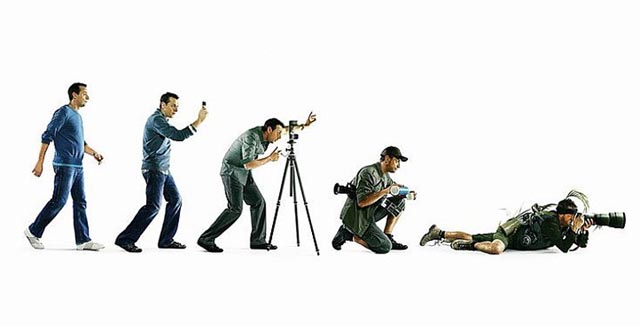
- Evolution of a photographer (via Scott Bourne).
Labels: amazon, apple, backup, birthday, cancer, film, geekery, linksofinterest, music, news, olympics, photography, politics, religion, science, space, television, twitter
09 June 2009
Keep on keepin' on
That makes two consecutive CT scans showing my tumours to be stable. This drug may keep me around for awhile yet.
But man, these side effects. Just got back to bed after another hour and a half in the bathroom. There's always a price to be paid to stay alive, I guess.
Labels: cancer, chemotherapy, ctscan
08 June 2009
Living for tomorrow
 Sometimes, for a few days, it's easy to forget how sick I am. But I found out I have cancer two and a half years ago, and I've been under some sort of treatment—chemotherapy, radiation, surgery, or recovering from those things—the whole time. Tomorrow I'll hear the results of my latest CT scan, good or bad. That will help determine what comes next.
Last night I hardly slept. I was in the bathroom at least once an hour, sometimes several times, right through till 6:00 a.m., and luckily my wife Air was able to get up and make sure the kids got off to school, which is usually my job. Side effects of cediranib, my current medication, kept me up. They're hard to predict, so when I felt them coming on last night I had no idea whether they might clear out my intestines in an hour, or whether it would take all night. All night it was.
I will also note, without further comment, that the bag of popcorn I ate when I took the kids to the movies on Saturday was a very bad idea.
Now I'm awake, taking some Advil and hoping to recover enough to get out of the house sometime today. Before she went out to her appointments this morning, my wife put a second coat of varnish on our stairs. They look good, and there's a fan helping them to dry. We need milk and butter, the baby chickadees are growing in our birdhouse, I love my family. Life continues.
Labels: cancer, ctscan, family, pain, sleep
26 May 2009
An extroverted introvert
 People are supposed to be either introverted or extroverted, but I've never been sure where I fit. Perhaps I'm an ambivert (yuck, an ugly word):
- Most of the time, I like meeting new people; I have stage love instead of stage fright (hence why I've taught courses, given speeches and been in a band for so long); I'm decent with small talk at a party or in a crowd; and I can be quite a chatterbox—not to mention loud—in the right context.
- On the other hand, I always enjoyed being an only child; when I'm uncomfortable or in pain I tend to become quiet and withdrawn; I despise making unsolicited phone calls and am not fond of telephone conversation in general; when out and about (either in my own city or somewhere else) I'm far more likely to wander about alone, take pictures, and think to myself than to strike up conversations with strangers; and I need significant time alone every day, time I often take when the rest of my family is asleep.
So I found Sophia Dembling's "Confessions of an Introverted Traveler" (via Kottke) fascinating. I like her thesis:
Though I don’t need to talk to a lot of people, I love watching them. [...] I travel for the travel.
I suspect I may be primarily an introvert—like Dembling, I find the North American preference for extroversion a bit oppressive. That doesn't mean I prefer solitude in all circumstances, but that social interactions take energy for me, and I need time alone to recharge. I like activities with friends, and especially with my wife and children, but given time to myself, I'm unlikely to want to meet anyone for lunch or a night out. Instead, I might go out by myself, and it doesn't feel at all lonely.
I recall last year's Gnomedex conference in Seattle, an intense three-day geekfest of ideas and discussion together with hundreds of my peers in a Seattle meeting room. The hotel my wife and I chose was a good 20-minute walk away up the waterfront escarpment and through downtown. Despite the physical difficulty of making the trek with my rolling bag of computer and camera gear while suffering cancer-treatment side effects (as I still do), I enjoyed the trip each day. That's because I could be alone and enjoy people-watching as I trundled through the glass tower canyons and Pike Place Market, and either charge up on the way to the meeting, or get my energy back on the way to the hotel.
Right now is a good example too. I've had a rough couple of nights of side effects this week, and my wife is out for the afternoon, but now that I'm finally feeling good, rather than setting up a lunch meeting, or saying hi to my parents (who live next door), I'll probably just go for a solitary walk. That's just what I need.
Labels: cancer, chemotherapy, family, friends, psychology, travel
20 May 2009
Ouch
 Okay, maybe we did pay a price for our fabulous little trip. Not because of all the heavy food, but from the intensity of the activity. Aside from our outings, we also did a bit of shopping and quite a lot of swimming in the hotel pool. So, after all that, once we got home, my cancer medication side effects kicked in and I was in the bathroom till 2 a.m.
Then, this morning, we were all so wiped out we could hardly struggle out of bed. The kids were tired enough that I kept them home from school so they're in better shape for Thursday (or maybe after lunch today), and I've been resting. Alas, my wife had to make her way to a couple of medical and dental appointments, so she dragged herself out of the house.
Anyway, I think the weekend was enough of an educational experience that it's okay for the girls to miss a bit of school. The Woodland Park Zoo and the Boeing factory are a killer field trip, right?
Labels: cancer, chemotherapy, family, school, seattle, travel